
Someone should write a book
How do you save the press?

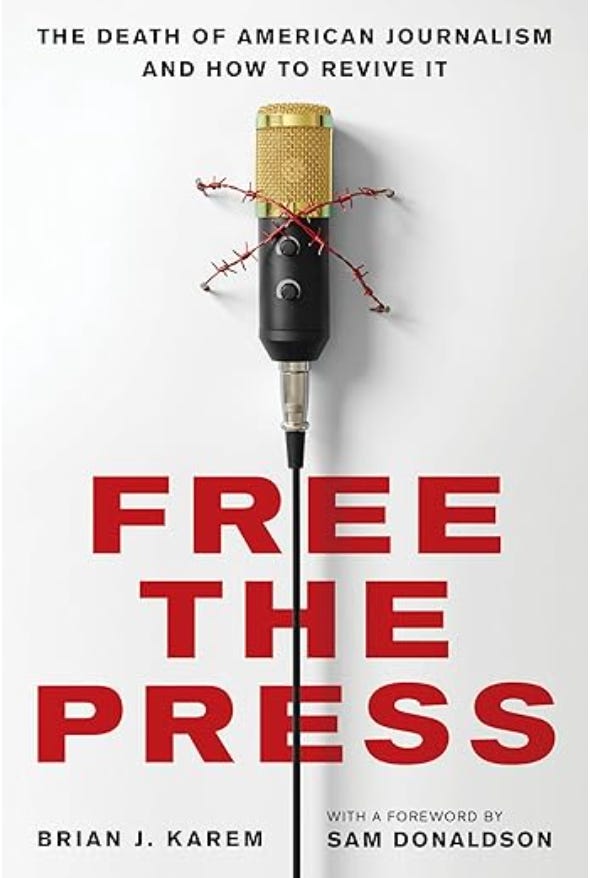
There is much clamoring these days for fixing the free press. Our President abuses us. The corporate owners have sold us out. Independent media is staking its claim for prominence - and yet just four or five companies own most of the platforms used by independent journalists.
That’s the same number of companies that own corporate media. It’s all a shell game.
I have been jailed four times. Hauled before grand juries. Beaten. Threatened. Testified before legislatures and congress. I have covered crime, war, politics and defeated Donald Trump in court three times to secure my press pass.
This is my lane and I’ll claim it. We can save the press. But it will take everyone of us to do it.
I wrote a book about this. You can buy it wherever fine books are sold.
Here’s the introduction. I hope you care enough to read that.
This is a cautionary tale I hope and not a postmortem though it may
seem like one.
I also hope to present solutions to the problems written about here, You may or may not agree with them, but I hope you think about them— at least a little more than we think about the clickbait that passes as journalism on a variety of platforms these days. The tale is about the apparent death of independent journalism. After thirty-seven years in this business, I can tell you that reviving it will take a herculean effort. Considering who got elected president in 2016 and how the 2020 election turned out, it has become more difficult to do so, but I retain faith that it can be done.
For four years, the Donald Trump administration promoted lies daily in press releases, in appearances on television, and from the bully pulpit available to his staffers in the James S. Brady Press Briefing Room or on the macadam drive outside of the West Wing. But Trump also did so through a number of social media platforms—especially Twitter. Those lies bounced around inside informational silos like Fox News, OAN, Newsmax, and more. The more they bounced, the more attention they got and the more believable they became to millions of Americans. Even when CNN, the New York Times, or other large media outlets point out the lies, they did so by repeating the lies first. There seems to be no way to avoid this cancerous invasion of our news with lies, half-truths, and bad fiction.
But Donald Trump is merely a symptom. He’s the result of forty years of the government and corporate media owners engaged in a systemic destruction of the First Amendment and free press.
As the story goes, in the summer of 1962, President John F. Kennedy arrived for a visit in Louisville, Kentucky. My dad, a dedicated Catholic and Democrat, watched him land, and, with me in his arms (l was approximately a year and a half old), he pushed to the front of the crowd of well-wishers gathered at the airport to see the president.
A former football player and at the time a spry twenty-two years old,
Dad had no problem getting to the front of the line, thereby getting a chance to see the president, and in the process, he unknowingly showed
me my future purpose.
As he reached out to shake the president’s hand, “he put you down to
do so,” my mother later wrote in my baby book.
I don’t know where Dad intended to put me down-perhaps on the tarmac. But mom also said as Dad did, so the “president picked you up and held you and asked you what your name was.”
My response? Well, according to my father, I urinated in my wonder-
ful cloth diaper and consequently all over the president.
And as my father later told me, “You’ve been pissing on politicians
ever since.”
The truth is politicians have been pissing on us since before I was born. But they really picked up their pace when Richard Nixon got into office. He tried to leverage a foreign government to the bargaining table during the Vietnam War in order to secure his election. He was notorious for trying to manipulate the media, and when he couldn’t do it to his satisfaction, he put some of his minions, including Roger Ailes, the future architect of Fox News, to the task of reinventing the media to his liking.
Nixon resigned. Roger Ailes stuck around.
Ailes found his success with two key politicians in the 1980s-Ronald Reagan and Kentucky senator Mitch McConnell. His main media accomplice became Rupert Murdoch.
With Reagan, Ailes found a man who would systematically deconstruct the media, allowing multiple media ownership, deregulating the airwaves, and ultimately getting rid of the fairness doctrine. Reagan, in turn, credited Murdoch and the New York Post for his 1980 victory in the presidential election. Reagan later waived a prohibition against owning a television station and a newspaper in the same market so Murdoch could continue to control the Post and the Boston Herald while he expanded his television presence in both markets.
With McConnell, Ailes found the key political ally who would put party over country and, as planned, would help out friends like Murdoch and eventually Sinclair broadcasting.
I joined the rank of professional reporters shortly after Reagan got into office—at a time when afternoon newspapers were dying because televi-
sion news was taking the audience and I’ve remained in the profession through never-ending downsizing, constriction in the business, and the rise of the internet.
Most of the places I have worked during the past thirty-five years have been bought, sold, or closed. The first newspaper I worked for while still in college was the Kingdom-Daily Sun Gazette in Fulton, Missouri—a town made famous by the book Kings Row and also famous for being the site of Winston Churchill’s “Iron Curtain” speech. That newspaper no longer exists.
The newspaper I joined when I left college, in Conroe, Texas, the Conroe Courier, is a shell of its former itself. I recently visited the offices.
They are closed. Gone. That newspaper was bought and is run from outside of Conroe. Consequently, it has little presence in the local commu-nity. The newspaper and television stations I worked at in Laredo, Texas, the Laredo News and KLDO-TV, are no longer around. WKYT-TV in Lexington, Kentucky, which afforded me my first chance to go to the White House briefing room, is the only place I worked that hasn’t changed dramatically. Both the Courier Journal and the Louisville Times, the latter of which was routinely listed as one of the top ten newspapers in the coun try some forty years ago, are dramatically different. The Times closed, and Gannett bought the Courier Journal after Barry Bingham sold it because of a family dispute. Gannett consequently turned a great newspaper into a gastrointestinal statement.
There are many causes for the collapse of these newspapers and television stations. Arguments can be made for cultural, economic, and a variety of political factors leading to their downfall. These are all relevant and will be explored at length. But many of these factors are merely symptomatic of an overriding cause government intervention. Although the press was set up to be independent and the public’s best chance of holding politicians accountable to the public, during the past 200 years, governmental contempt for the press and economic pressures have led to thousands of tiny cuts in press revenue and transparency and ultimately have lessened the ability to hold government accountable-making many papers, at times, almost unreadable.
The government has removed requirements for public notice ads. It has made public information inaccessible except through expensive litigation or cost-prohibitive reproduction charges. It ended the fairness doc-trine. It sold the public on that move by claiming government action would assist free speech. That was the real coup. In the end, the government turned around and blamed the media owners for the problems-though it
was the owners that bought the government con—or helped spread it for
the sake of their own bottom line.
Thirty years of this governmental manipulation finally led to Donald Trump’s proclamation that reporters are the enemy of the people and a sizable number of Americans believed him then and stil do now. Far from being the enemy of the people-we are the people. True, a press pass allows access to the front seat of the theater, but the price of that front-row seat has heretofore been to hold politicians accountable by asking them the hard questions.
The government has hobbled these efforts by legislation, by regula-tion, and by bribery. Holding out access like a journalistic carrot on a stick, presidents have silenced individual journalists, while legislative and regulatory efforts have reduced the number of independent media companies and thus the overall number of reporters.
Journalism has long attracted young professionals with good minds and an independent nature, but keeping them in the past four decades of constriction is difficult. Institutional knowledge is not what it was when I first became a reporter.
I’ve watched young children die. In covering crime, I’ve seen hundreds of dead bodies in various states of decomposition that would make horror movie special effects wizards vomit. By my count, I witnessed twenty-two people take their last breath on this planet. I still remember their faces.
They were police officers, criminals, old people, car accident victims, and one eight-month-old baby boy whose face and bare feet still haunt me to this day.
I’ve covered professional sports, wars, politics, county fairs, city council meetings, Congress, every president since Ronald Reagan, NASA, weird and big weather, earthquakes, fires, famine, and stand-up comedy.
I’ve worked in television, radio, and newspaper; on the internet; and for magazines. My life has been reporting on multiple platforms and on a variety of beats and has taken me across the world and back—and luckily on someone else’s nickel because working reporters still do not make squat.
I’m not the only reporter to have done this, but the constriction of the news business has led to far fewer of us—and thus far less institutional knowledge and as a consequence less comprehensive reporting. It used to be that you had to have a great deal of experience in order to be assigned the White House press beat. Today, kids are hired right out of college and paid low wages to handle what is one of the most important beats in the
world-covering the president of the United States. Is it any wonder the institution is looked on with such disdain?
Today, reporters professionally survive by being little more than stenographers-and without experience or mentors to guide young report-ers, it is a hellish existence.
Mentors on my journey include Sam Donaldson, Helen Thomas, Barry Bingham Sr., and many more hardworking, innovative, exceptional reporters and writers. Through my travels and my work, one thing has become breathtakingly clear to me:
From the moment I became a reporter, the government has systematically tried to destroy independent reporting. The government’s intended rise of corporate journalism—as Ben Bagdikian told us in The Media Monopolyhas assisted in destroying the Fourth Estate and free speech.
Today, there are fewer reporters to cover more people than at any time in my life. The prime example is in Laredo. When I moved there in 1984 to be a county reporter for the Laredo News, earning my first chance to cover a presidential race, there were two daily newspapers, three network-affiliated television stations, and several radio stations servicing a population of 100,000 people. Since it was on the Texas-Mexico border, there were also two Spanish-speaking newspapers and one Hispanic television station.
Today? One newspaper, one television station, and 300,000 people.
The federal, state, and local governments that accomplished this task have opened us up to fascism and sowed seeds of doubt into our most cherished democratic foundations. A lack of education isn’t a new story-but the federal government’s promotion of it is. It has left people providing and believing “alternate facts.” It leaves every reporter from a small-town lowa community newspaper to a reporter for a network or the New York Times being labeled “fake news” or the “enemy of the people.”
In a country where press freedom is guaranteed in the First Amendment to the Constitution, we are today, according to Reporters Without Borders, ranked just forty-fourth in press freedom. Peaceful protesters are gassed outside of the White House while reporters are beaten and threat-ened. Our press freedom continues to erode, and no one, it seems, wants to address why or how this happened. It seems we only want to attack each other.
That’s the problem.
There is a solution.
Excellent, Brian. Wish I could think of a way to bring REAL newspapers back. Growing up, we always had a paper delivered EVERY DAY. (Well, OK, not on holidays!). We had Newsday, the Long Island Press, and the New York Times. My parents just had the Long Island Press delivered, but we could get the New York Times and Newsday delivered if we wanted it. Also available in the stores. I can't remember when the Long Island Press folded. I think it was sometime in the 1970's. Didn't know why, but from what you wrote here that just might have been the reason. Newsday was still in print, however. I've been out west (Washigton) since 1982, courtesy of my husband being in the Coast Guard. I don't know if Newsday is still in print. Probably not.......